Monday, 8 October 2012

Windows RT Moving Away from Freedom of Choice

Microsoft is starting to seem like it might be slowly edging to an unwanted platform with RT. For those wondering, Windows RT (formerly known as Windows on ARM) will be a version of the Windows 8 operating system for ARM devices such as tablets. The RT acronym does not officially stand for anything. 
Recently announced, applications that will run on RT has to be 'certified' by Microsoft to be added to the list of programs on their store. This means that similar to other platforms such as Apple's Mac, not all programs will effectively run on Windows RT if it hasn't been checked by MS to adhere to certain standards. 

Now, although this is good in practice, the one thing that made the PC as a computer original was its compatibility and changeability. With a PC computer you always have the choice of using computers like you want, customizing it completely. Sure, there were multiple compatibility problems with various systems, and there's no dodging away from that. But although not as open-formed as Linux, Windows gave you options by not limiting your choices. 

Windows 8 won't have this system yet, so its still free game, but the direction that Microsoft is moving might be a troubling one for those who enjoyed the freedom that a PC offered with Windows' open system. I personally also enjoyed the large choice I had with Windows and PC's so far, leaving me slowly losing even more faith in Microsoft's new business model.

Tuesday, 18 September 2012

More Copyright Drama starring Apple, HTC and Samsung


As I speculated in my previous article, copyright infringment wars continue on, and this time Apple is allegedly in the crosshairs of both Samsung and HTC following the release of their newest edition of mobile smartphone, the iPhone 5. 

In 2009, the LTE (Long Term Evolution) standard, or how its more widely known, 4G LTE, has brought about numerous patents containing the various designs of wireless communication used for mobile phones to the table, but it has never seen the light in Apple's device until the recent release of their new iPhone.  This has prompted Samsung to imply that they would be suing Apple for patents they hold in conjunction with the LTE standard. Although originally one would think this is simply Samsung throwing a tantrum for their previous loss, they actually might have some lean in this matter. 

Samsung has run an LTE network for quite some time, and they might have some pull if they were to pursue charges of patent infringment.
Similarly, HTC also indicated a possible law suit against the importing of iPhone on the grounds of patent violations, especially since an ITC judge, Judge Thomas Pender stated that they would have to overwhelmed with evidence to have any ruling against the patent infringement claim by HTC, which bodes well for the mobile device company.

Apple seems to have stepped onto a landmine here, and although they have the finacial backing for another lawsuit, their chances of winning might be slim as it stands now. We'll have to see what more horrors await Apple if the suit comes to life.

Friday, 31 August 2012

Hardware Copyright Battles

Since 2011, the heated battle between Samsung and Apple has run wild, creating stirs in the internet community and the world. Apple sued Samsung for various copyright infringements including Samsung's Galaxy Tab and their Galaxy phones. In response to this attack on their validity, Samsung counter-sued them with similar claims of copyright infringments with Apple's Iphone and technologies. 

So, the last month the court drama came to a climax with final arguments and evidence being presented by both parties. Then, a few days ago the final verdict was given by the jury and Samsung was slammed with a 1 billion dollar damage payment for infringing on a lot of Samsung's best-seller mobile devices. This is surely a hard hit for Samsung, not only against their pockets, but also their reputation. 

The whole debacle has thrown copyright infringements back into the spotlight. Recently, and less in the news, was the Oracle vs Google infringement case. Oracle sued Google for allegedly infringing on Java patents with their Android operating system. 

For years, technology has been fragmented more than it is today in the sense of advancements, that made it a lot harder to infringe on existing patents. But in the past few decades, technology, and specifically computer technology has grown to include many standards. And the more standard something is, the closer it gets to being the same as another guy's own design. 

A few older cases comes to mind, such as Apple's claim against Psystar in 2008 for their 'hackintosh' systems that came loaded with Apple's OS.

It is the opinion of many a internet-blogger that Apple will be going after Google next, for various infringement they have committed against Apple's devices. Google has been going strong with innovation, but perhaps they are running out of ideas? More and more things they release are starting to feel like copies of other people's work. Such as their Android system's similarities to Java and other related mobile operating systems (such as Apple's own mobile OS, iOS). Apple has always been intent on their patents, and have been hunting copycats for years.

If there's one thing we have learned from this court drama between Samsung and Apple, its that you can only get away with blatent technology theft for so long. Don't get me wrong, I use a Samsung phone myself, which is like a small, less fancy iPhone. But in the end it is so close to Apple's phones that I agree with the verdict of the court on this matter. In my opinion, we might see more copyright lawsuits come up after this case, as it has set a precident for copyright infringement.

Tuesday, 14 August 2012

Microsoft RT and why you can't say 'metro' anymore


The line between Netbooks, Notebooks and Tablets are slowly merging into one gigantic pool of confusion. Recently, with the release of Windows 8, Microsoft also announced a version of their software that would run on ARM devices, which in essence will be in between a tablet and a laptop. But what is Windows RT as it is called, and what makes it different?

Windows RT is simply abbreviated letters for Runtime, which is the name of the engine that runs the "Metro" apps. Unlike the regular version of Windows 8, RT will be sold directly to manufacturers and will be preloaded on RT devices. Those will often have a detachable keyboard, but also a touch screen so that it functions both as a laptop and a tablet. It will only run apps downloaded from the Windows Store, similar to a tablet or smartphone.
RT Tablets will supposedly have longer battery life, faster gesture support, NFC(Near Field Communication) and better graphics than other tablets, according to an article on Cnet.

This effectively creates a new level of computing device that falls somewhere between the currently popular tablets, and the more powerful notebooks or laptops. Netbooks have all but died in the market with the tablet revolution currently in effect.

Dell, Lenovo and Samsung will be developing Windows RT computers, and Asus has already announced a RT tablet in the works.
One version of the Microsoft Surface, their own tablet, will also run Windows RT.

Windows RT will not include Windows Media Player, but have a RT version of the new office.

With all the hype in tablets, Microsoft is really putting out to fit the market, and in my humble opinion, they are not doing a bad job. They have been aiming high since Windows 8's announcement and so far they have not dissappointed where the big picture is concerned. We will have to wait and see if the Windows RT tablets are feasible in a market where Apple and Samsung already flies high.

While we are on the subject of Microsoft, they have recently changed the official naming of the 'metro'-style appearance of Windows 8 to simply calling it Windows 8. The reason for this is that they are stepping lightly around using the name after German retailer Metro AG supposedly implied that they were unhappy with Microsoft using the name. According to MS, the name was more of a code name that they would slowly change away from when the OS was finally released, but personally I think the name will stay with us forever. The dreaded Metro, so user-friendly that people like me will dislike it because it is too automatic for my taste.

Microsoft is busy this year, and many are waiting for the release of Windows 8 in October when RT, Windows Phone 8 and the Surface will make their appearances. We'll see how it all pans out in the end.

Tuesday, 7 August 2012

Curiosity has landed


Having been flying towards Mars at a steady pace for 36 weeks, NASA's Hi-tech, unmanned, planet-driving, automated explorer 'rover', dubbed Curiosity, landed this past Sunday on the red planet, and have already sent back images for the whole world to see.

The rover is as large as a car, and was carefully lowered using pinpoint calculations via a sky-crane and various complicated manoeuvres. Powered by nuclear power, and sporting dozens of different instruments, it is the largest rover to be used by NASA's Mars Science Laboratory and its main purpose is to determine of Mars ever sustained or could sustain life.

It has landed in the Gale crater, which is believed to contain sediments of millions of years, and could provide valuable insight to the history of the planet.
The Curiosity has already sent back several images from its landing point, but in the coming few days or weeks the mast will be deployed which contains a high-resolution colour camera.

Some internet sources speculate that after this the next logical step would be to put a man or woman on the red planet. Whether this sci-fi thinking will become reality remains to be seen, but the whole operation is a credit to humanity and computers.

Monday, 25 June 2012

Microsoft goes tablet

MS Surface
The Microsoft Surface
Microsoft has been busy this week. From announcing their expansion into the mobile market with the Surface, to the new Windows Phone 8, they have certainly pulled the spotlight on themselves this month.  When you think of Microsoft, you always think of their software, and the widely successful XBOX consoles. But, this week that changed.

Microsoft's business model has always been mostly software. Save for the gaming console expansion, they had concentrated all their money and work into their big software titles such as Windows, their games, and various other offerings such as Windows Phone.
With the announcement of the Microsoft Surface, one has to wonder what they are up to. It seems a bit out of their field of expertise, considering that most of their hardware offerings are made by third-party partners, such as the Windows Phones. But then again, they are good at surprising us.

The Surface is basically a standard tablet. It will run Windows 8, which with its 'metro' style tile system could be the ideal operating system in the case of mobile computing. Unlike many of its rivals, the Surface will come with a detachable touch-pad keyboard. This allows you to stand it up similar to a laptop or netbook computer. Various rumours are floating around the net, including things like Wi-Fi only connection options, a price tag that will range from $700 to $1000, and full integration with Live, which is of course the same way Windows 8 will work.

MS has been known to go extravagant on many things, and I'm sure this will be no exception. Include with the Surface the soon to be released Windows 8 (which we will assumedly see in the Northern Hemisphere fall) and the new Windows 8 phones that are coming out sometime next year, Microsoft is stacking their cards up on the new mobile venture.

We will have to wait and see what their future will hold.

Wednesday, 13 June 2012

Desktop Experience

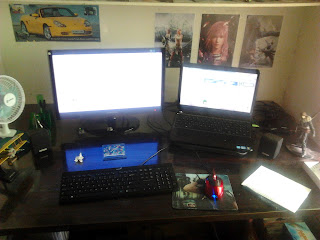
my setup at the moment
My Setup at the moment
Today, while browsing various sites and also checking an e-mail, I've come across a few different setups that various users have for their desktop workstations. This ranged from a simple screen, keyboard, mouse and chassis setup, to a much larger dual screen, printer and 2.1 sound system.

Personalizing and enhancing your workstation can help make you feel more at home while sitting at your desk, and enjoy your music, games, work, browsing or other activities so much more. A few things that can help out in this regard : 

An extra screen is always a nice touch. New computers quite often comes with mulitple screen ports. Digital outs, VGA outs and these days HDMI is commonplace, and extending your Windows Desktop to two screens gives you so much more space. You can place commonly used applications on the one screen, such as your IM messenger, your music program of choice, and even widgets for weather, or time, or any other desktop interactions you like to have handy. The extended screen makes your computer feel much bigger and spacious, and you feel better running things in full screen knowing that you still have visibility of your instant messenger.

Speaking of desktop apps, with the new Widget system of Windows Vista and 7, and with a multitude of desktop-based applications available on the internet, its always an enhancing experience to broaden the use of your desktop, especially when you use multiple screens to display. From showing a picture from photobucket to giving highlights of feeds you frequent, there is always useful and entertaining widgets and desktop apps on the internet.

Further things to consider:
- Although small speakers are sufficient for most things, you can get a 2.1 speaker set these days for relatively cheap. Listening to music or playing games with just an added subwoofer and better quality speakers can make a huge difference on how your computer sounds.
- USB hubs, (externally powered ones are recommended) is a very useful tool to have handy when you use various usb devices. Especially these days with smart phones and mobile devices becoming integrated with computers. USB hubs give you easier access to the ports as well, and when powered will provide sufficient power to give you the best experience when syncing mobile devices. 
- Spaciousness is an important part of the desktop experience. When you sit and work on a cramped table, with no space to move your hands or even the mouse, it becomes a chore to do work on your computer. Having a spacious table with ample room for all your computer peripherals will make you feel so much more professional and satisfied when you work on your desktop. 

Many other things can be attributed to the experience of enjoying your computer, but those are personal preference, such as color of the chassis, mouse size, keyboard style, and extra devices such as a tablet for drawing, or a headphone-microphone set for gaming. 

I hope you gain some insight after reading this, and improve your desktop experience.